Oh Natural!

Disclaimer! I am not a scientist. When math in high school became more about letters than numbers, I knew I was out of my depth. My most direct experience with physics is when I stumble over a root while running, and gravity and inertia take me down. Though I am not trained in science, I am curious, and I find these fields very interesting.
Science seeks to understand how the natural universe works, and I appreciate that goal. Wondering about the universe and humanity is one of my passions, and I try, in my way, to make sense of it. Lately, I have been fascinated by a science concept called entropy. More specifically, I am interested in its opposite, negentropy or syntropy.
Entropy is a term used in physics, biology, and information technology that describes the increase in disorder, or the increase in randomness in a system. High entropy means that energy is more disordered or dispersed, while low entropy means that energy is more ordered.
Things move from order, organization, and complexity to dissolution, disorder, and chaos. From low entropy to high entropy. That this happens is obvious. Water changing from solid ice to liquid water, then to gas is an example of increasing entropy.
Though it will take a long time, a shining pickup truck parked outside in the woods will eventually degrade. Functionality fades quickly as the battery goes first. Paint will fade and pock. Upholstery will crack. Air will seep out of the tires, and the windshield will break. Eventually the car will be barely recognizable, a pile of manufacturing residue.
Another example of changing entropy is a rechargeable battery. When charged, the battery is in a low-entropy state. Its energy is ordered and dense. As we use the battery, we end up dispersing its power. As power drains, entropy increases. It takes an investment of energy through the recharge process to bring the entropy of the battery back down.
This all seems pretty straightforward. Energy is spent organizing, clumping stuff into low-entropic states, then over time this dissipates and as it does, entropy increases.
A drinking glass is an organized set of material (low entropy) that, when dropped, smashes into many disorganized bits (high entropy). The direction here is obvious. Those shards do not reconstitute themselves back into the drinking glass.
The low-entropy drinking glass exists because we intentionally produced it by applying manufacturing process energy. How about low-entropy states in the natural world? How do organized, complex, low-entropy states exist in nature? Why is everything in the universe not fully randomized and chaotic by now? To delve into this, we can introduce entropy’s opposite, syntropy.
Syntropy is the tendency of systems to increase in order and complexity. I immediately think of life. Life is syntropic. Somehow life emerges from chaos. Cells replicate and divide, and the organism grows. It becomes more complex and capable. It sustains itself and heals itself when harmed. Living beings seem to go the opposite way of entropy on their own. Entropy decreases and syntropy increases naturally. This is so astounding.
If you research syntropy, you will find examples detailing chemical and biological processes that increase order. The specifics, the biochemical aspects involved, are interesting but more complex than I can clearly describe. What I want to note is just how wondrous this is from a philosophical perspective. That synergy happens at all is profound. It is the natural equivalent of a miracle. With life, this occurs all the time. Our world is teeming with it. If we seek something special to amaze us about the natural world, this is it.
As a curious, but non-scientifically trained person, I have some questions. How do microscopic elements combine and organize? DNA gets copied, cell components arrange themselves, and then the cell splits. This is amazing, but how does it happen? And how does the syntropic act of healing work? Organisms heal wounds very well. These are such interesting questions that lead me to wonder about what specific functionality drives syntropy.
I think biological syntropy needs some underlying intention. It seems like there must be an inherent goal or urge among elements, molecules, etc. to form up and order themselves. Besides intention, I think there is a need for a feedback loop or awareness of some sort as the organization grows so that it can adapt to circumstances. This is a bold statement, but I can’t see how cells achieve syntropy without these elements being active.
Organization takes intention, awareness, and expenditure of energy. Consider the example of racking the balls on a pool table. There must be intent, awareness, and work. Intention is the will to order the balls in a triangular shape. Awareness is locating the balls as they lie on the table. Energy expenditure is the physical work of racking. This type of organizing work, without the triangle or pool table, happens in life all the time. This shows just how mysterious and awe-inspiring the natural world is.
I have heard people suggest that the phenomenon of syntropy implies that a supernatural God designer makes it happen. I’ve seen arguments that draw a similarity between a book and its author and the natural world and a supposed author (God). Some people believe that there must be a supernatural God behind the scenes orchestrating this syntropy. I disagree. I think they reach that conclusion too quickly.
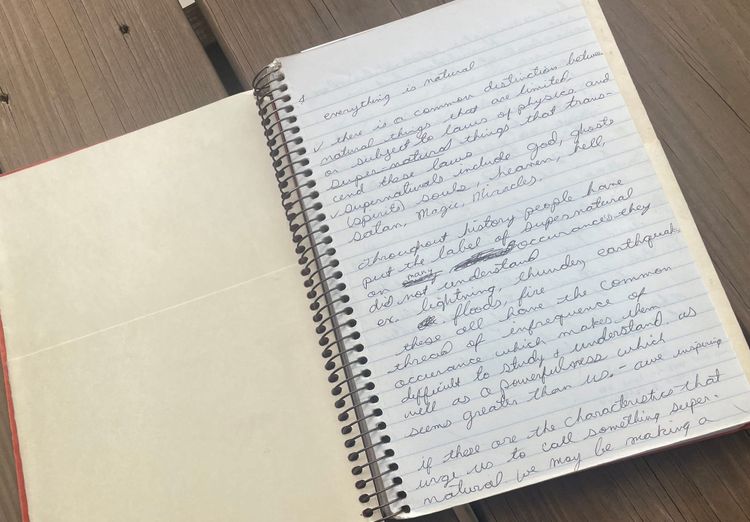
My view is that we should explore and exhaust all natural causes before we decide supernatural forces must be responsible. Our default view must be that anything that happens, even the wonders and mystery of syntropy, is natural until proven otherwise. Having the view that anything that happens is natural is essential because it allows us to slowly and carefully make sense of the natural world. The supernatural world, if there is one, is outside of the rules, logic, and reason. Attributing phenomena as being supernatural takes the topic off the table of understanding and puts it in the zone of faith and fable.
When we jump to the conclusion that something must be supernatural, then we eliminate our ability to truly know and explain it. Phenomena we designate as supernatural are simply unknowable. Without the possibility of understanding, we can’t reconcile the opinion of one person with the view of another. No forward progress is to be made. We can’t reconcile differences that are in the zone of faith and fable.
OK, it is no surprise that I won’t conclude that the wonders of life are supernatural. But how does syntropy happen if God or the supernatural does not drive it? What natural forces make this happen? I think syntropy, growth, and organic organization happen through the influence of a distributed creativity feature that exists within nature itself. While I do not know, I bet we eventually find that the essential elements I mentioned above, intention, awareness, and expenditure of energy all are part of the natural world.
In Natural Wonders, I wrote. “The characteristics of intelligence, order, wisdom, and so forth are right in the fabric of existence. I don’t believe in a supernatural God, a chef, planning and crafting this magnificence. Like everything else, order, wisdom, reason, efficiency, and beauty are elements or characteristics of the Universe.” Could it be that intelligent natural forces, largely beyond our current understanding, drive syntropy?
Continuing in Natural Wonders, I suggest that the Universe contains intelligence. “We see intelligence as an attribute of an individual, as in “this person or animal is intelligent.” Perhaps intelligence is not a feature of us, not something we have. Maybe it is an impersonal attribute or force of the Universe, and we take part in it. We don’t own it. We use it. It is not of us so much as we are of it.”
Allowing that a mystery as grand as syntropy could happen naturally is freeing and exciting. With this one change in our outlook, suddenly we see that the world is not something managed by an outside force but is self-directed and made of the same stuff as us, available and potentially knowable. The subatomic attributes, the particles, waves, etc., that make up the world may turn out to contain everything. Fully everything. More than we ever imagined. For me, this is a liberating and enriching view.
My dad and my older brother were both skilled gardeners. Particularly my brother, who was a master gardener and worked a community plot for many years. Writing now about synergy and life organizing itself makes me wonder what these two loved ones thought of the synergetic marvel of growth. I can imagine both of them occasionally taking a moment of reverence and awe when they saw a sprout unfolding, timelessly turning up toward the light. Did they attribute this magnificence to a supernatural God, or were they open to ideas like mine that all this brilliance is inherent in the way the universe works? My chance to chat with them on this has passed. It makes me wonder, though. I am confident that they saw plant growth as very special and amazing. Except for weeds! Those were from the devil.
Though I don’t know how syntropy works, I find these ideas so fascinating to think about. They give me a pleasant sense of connectedness to the whole. This natural Universe is rich, and we are in it and of it. Syntropy is a cool, genuine phenomenon that we see illustrated personally in daily life. We can celebrate each of us and the life around us as beautiful examples of this sweet organizational drive on display. Oh, this natural world astounds me!